Written by Allison Kimball

This summer, CELT staff and the Town Tree Warden walked among Cape Elizabeth’s trails to find eastern hemlock trees (Tsuga canadensis) with white wool-like masses indicating the presence of an introduced insect called hemlock woolly adelgid (Adelges tsugae), usually abbreviated to HWA. Sasajiscymnus tsugae (St) beetles were released onto these infested trees as they are a natural predator to HWA and part of a long-term effort to protect one of Maine’s many forest species.
You know you are looking at a hemlock tree if it is an evergreen tree with flat needles that, when mature, produces light brown cones about the size of a thumbnail. According to the National Wildlife Federation, hemlock trees are a conservation priority because their canopies provide habitat for birds like goldfinches and shelter for mammals like white-tailed deer and other wildlife during harsh storms. Their shade keeps streams with brook trout cool, they increase water quality by filtering runoff through their roots, and they help maintain the structure of soil to prevent erosion.
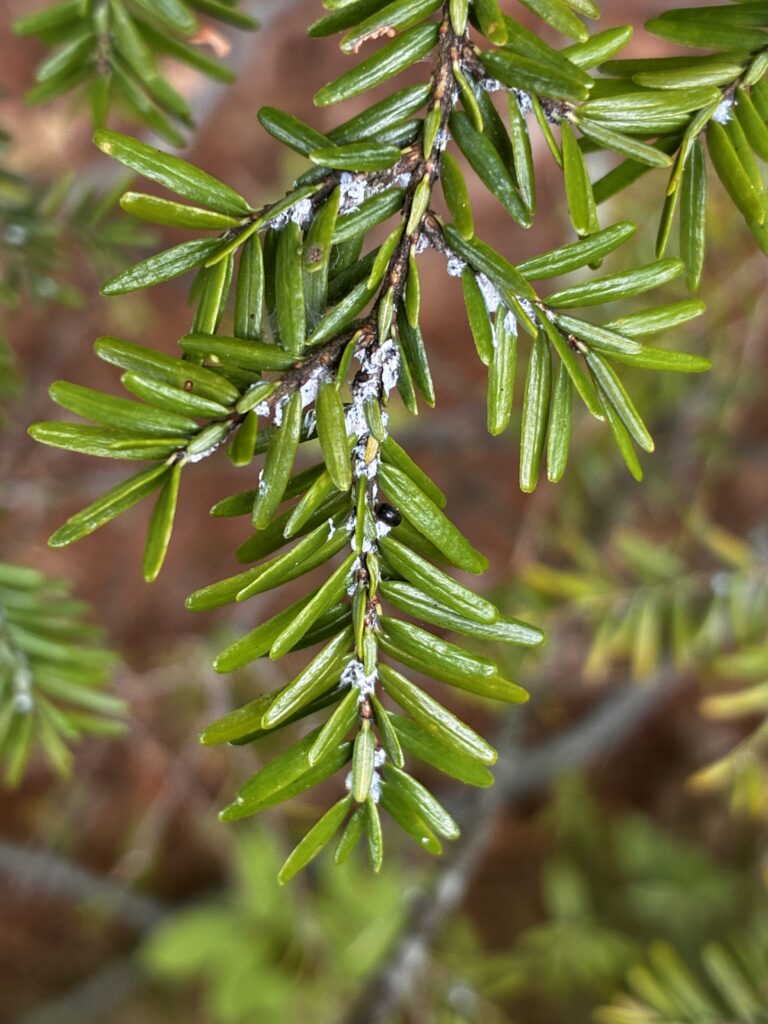

The Maine Department of Agriculture, Conservation, and Forestry confirms that hemlock trees are the only species being affected by hemlock woolly adelgid. For some context, after its introduction from Japan, rising temperatures allowed the HWA to expand from the southeast US northward, reaching us here in Maine. You’ll know if your eastern hemlock trees have become infested if you see white dots that don’t move on the underside of the twigs at the base of the needles. These are the wool-like egg sacs formed by active nymphs during winter that weather away by late summer. They feed on the nutrients stored at the base of the needles. This causes their canopies to become thin or for branches to die back, eventually causing the hemlocks to completely die when heavily infested.
We chose to take a biological approach for long-term control instead of commercial pesticides, since they can establish themselves independently for many seasons, are chemical free, and their population grows and shrinks in line with the amount of HWA in the area. The St beetle is a natural predator to HWA regardless of its lifecycle stage and is the only biological control agent available for the public to buy. They are host specific, so there is no concern about them preying on other insects outside the intended species.


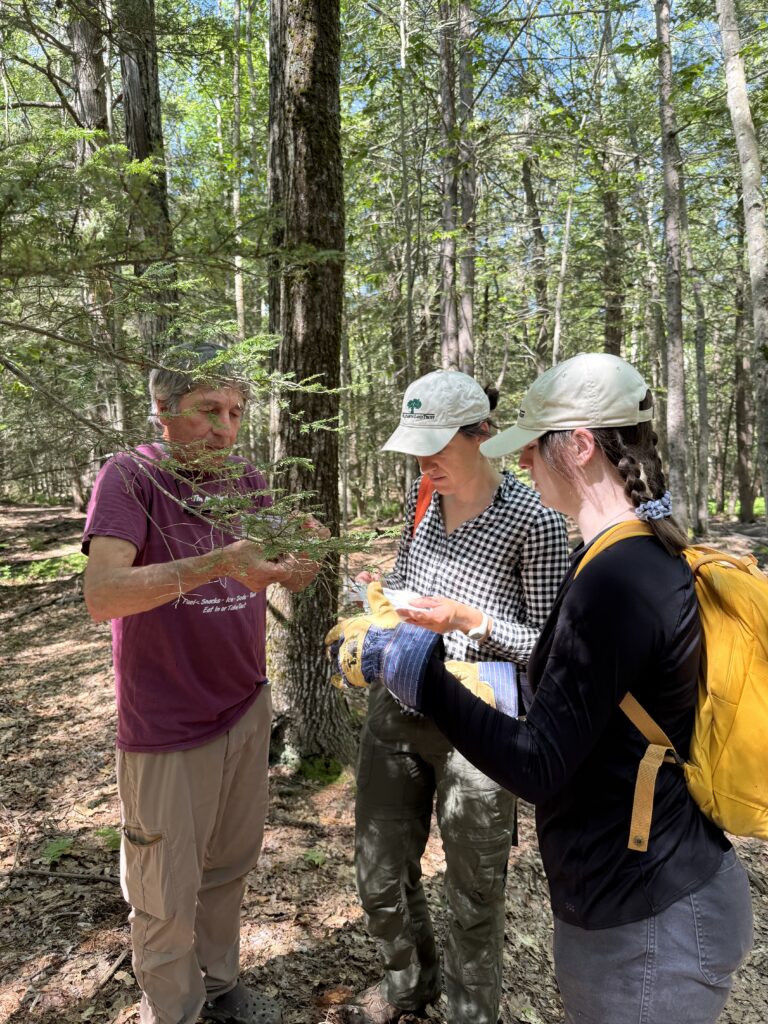

Tree Savers rears and sells these beetles, providing instructions for releasing the beetles. After identifying the eastern hemlocks effected by this pest and purchasing these beetles, you can go out and attach their colony to the branches just as we did. Feel free to reach out to us, the Town Tree Warden, or Tree Savers to learn more and take the next steps to save hemlock trees from hemlock woolly adelgid!